Saturday, December 15, 2012

Social Networks ? Social Directories !


vs


All "social network services" have technically started out as list of names - people directories. Each person file has fields like name, age, interests etc. In that they are modern versions of phone books or telephone directories which offer extended information about a person, professional data traditionally called a CV and personal info, such as interests, hobbies, likes and dislikes, personal historic data. And the predecessors of the now called social network services were naming themselves just that, for example "the facebook", the digital version of a college "yearbook".


The next design task was to manage the access to that information. Who is allowed to create a record, who is allowed to edit that data and for social network services most important, who is allowed to read a record, or parts of that and to add some additional info such as a comment, a link or a photo.

Who is allowed what and to whom do I relate to, family wise, professionally and socially, that are nowadays the most important features of social network services.

But  - those are in fact by design not social network services, but more accurately social directory services.

A network concentrates on connecting the nodes, a directory of that network would simply list nodes in a network. Designing a network is looking at the connection, the link, the communication. That is done through links, cables, tunnels, streets, rails, pipelines, routes, veins, arteries, stairs, corridors, lifts / elevators. Each follows codes, rules, protocols and regulations which allow some kind of transportation or flow.

You wouldn't call a house a network, though a network of media might run through a building.A big building has a directory, the list of names of companies or occupants and may even offer a direct "access" -  buzzer. A town is usually not designated as a network, however the streets connecting the houses form a network.


In the same way is a social network service basically a directory of nodes - us, the people. Therefore we should call Facebook, LinkedIn etc what they really are: social directory services.

Social Networks are social structures of actors and the ties between the actors. Pictures of those can only be representations of fragments of these structures. If you were to design a social network, you would need to focus on the network aspect, concentrating on how people connect to each other, what rules to follow, how to scale. You create building blocks rather than a walled garden. Starting by creating the people database is saddling the horse from behind. The directory should be like a read out, a momentary scan of the network.

One of the rare exceptions of real digital social networks might be communication services like for example email services or Twitter. Those were designed based on network and communication protocols first.

And the fact that services like Facebook and LinkedIn are designed as directories, and not open networks, might be their biggest economic threat - rather than the next direct competitor.


Hierarchical Tree Structure: National Cancer Institute NCI https://wiki.nci.nih.gov/display/caCORE/Hierarchical+Tree+Structure+v4.3
Social Network Graph: Picture of Wikipedia, Daniel Tenerife, Ejemplo de diagrama de una red social http://en.wikipedia.org/wiki/File:Social_Red.jpg
Fernandodosantos, Lista telefônica Guia Fácil, edição de Blumenau para o ano de 2012 http://commons.wikimedia.org/wiki/File:Lista-telefonica.png
London Underground, en.wikipedia.org/wiki/File:TubeMapZ1_TFL.pngIntercom: Waldemar Gminski http://commons.wikimedia.org/wiki/File:Kaseta_4lx-15nr.jpg
Stages in the self-organization of a network, based on Nagler, J., Levina, A., & Timme, M. (2011). Impact of single links in competitive percolation by Takemori39, http://en.wikipedia.org/wiki/File:Network_self-organization_stages.png 
Network Overlay vy Ludovic Ferre http://en.wikipedia.org/wiki/File:Network_Overlay.svg
The Opte Project http://en.wikipedia.org/wiki/File:Internet_map_1024.jpg

Sunday, April 10, 2011

Management is a human invention

and often bad for creative stuff...

Why this talk? Because as Daniel Pink points out: extrinsic motivation like carrots and sticks is best for mechanical tasks as research has shown over and over again. Are managers and bankers really mainly doing repetitive tasks? If that's true, why are the rewards so high?

What we need for creative work is intrinsic motivation, autonomy, mastering and purpose. And that motivation is true for groups as it is for individuals. in fact social recognition is of course another driver.

At groupDNA we assume that in groups we behave similar to organisms. therefore intrinsic and extrinsic motivation apply in the same way. When working in a group conciously, we better make our mind up before we start organising ourselves. because once extrinsic rewards have been established, they may have irreversibly poisoned the group. And that is bad for economics as well.

tickerTXT is about market communities made of traders, producers farmers and transport people. Every market community will also have people taking on social roles within the group, moderating and acting as proxies. Some may dedicate a good deal of their time to work for the better of the group itself.

An autonomous market community needs to change and adapt. People will come and go. In order to work for all members, each participant needs to have the same vote. As members earn their income with deals and not as a salary from the community, the best form of such a market is based on cooperative principles.

Wednesday, March 30, 2011

150 - the right size for larger groups?

Watch "TEDxSanDiego - James Fowler - Back to the Village" on YouTube


At tickerTXT we were have been discussing since the beginning how many members a market in rural areas need and what the maximum number is. We don't have an answer and there probably won't be definitive numbers.

A market needs a critical mass to really be attractive to participants. That attraction is through network effects. The number of participants is relative to the "tangible" activity on a regular basis. People want to see things happening and expect deals to be closed regularly, that someone is potentially there to conclude a good deal.  You want to see many deals per day, but not too many, then sometime participants will quickly feel overwhelmed.

The other factor for a thriving market is security / safety and trust. Using the mobile phone SMS to engage in market conversations and to conclude deals I need to trust my counterpart. Trust does not mean I have to like the other person. It also doesn't necessarily imply that the other person doesn't cheat. But if I know that my deal partner is likely to cheat, I can hedge and protect myself. Trust works to the 2nd degree connection. You may trust someone you don't know through a person close to you.

Therefore we estimated that the largest working market communities would likely count 500 to 1500 members. Any bigger and there would be too much trade activity and too little trust because of the 2ng degree of trust limit.

Maybe a market is comparable to a village community. Then a market would count around 150 people. In order to thrive, they would need to be more active than a larger community with less individual trade activity.

Or a tickerTXT market could include several village-like communities within a market? Maybe not, because that would look to economists like cartels. Cartels are just like larger organised groups within a community and will likely fight for power. Markets work best if participants can do their business without political restrictions, when rules are fair and the deals transparent.

Monday, January 3, 2011

Friendship Paradox - Friends Are More Central To Social Networks Than You Are


Nicholas Christakis: How social networks predict epidemics


The friendship paradox says that most likely your friends have more friends than you have. And we can use that phenomenon to quickly discover the central nodes of social networks to identify the "connectors" - the people at the core of social webs. By looking at those "superspreaders" we can learn changes in social behavior far sooner than ever before, sometimes 2 or 4 weeks ealier than trqadiional methods allow in case of flu epidemics for example. We can also use those techniques by targeting these hyper-connected people to immunise populations more quickly and effectively in case of viral epidemics.

Of course these methods can be used for all kinds of behavior targeted actions, from spreading ideas to changing unhealthy behavior...

And when you look at those network charts Christopher Christakis is using, you can't help observing simularities to representations of organisms - so we can assume that social graphs represent our groupDNA.

Wednesday, December 22, 2010

Principles for Group Dedicated Technologies and Services - the groupDNA Brief

I thought about publishing some ideas and concepts about "technologies, applications and services dedicated to groups and organisations" one by one. But it takes time to write and edit these things :-) Before this day ended, I wanted to publish something for groupDNA and I re-read the paper I wrote with the help of Andy back in spring 2008. We have come a long way, but the principles are just fine. I would and probably will re-phrase much of this paper and publish these thoughts on groupdna.org. Anyway that's my plan for 2011, meanwhile enjoy this only slightly edited paper. Happy holidays :-)

here is the link to the Google Doc http://shortlinks.tickertxt.org/groupdna2008 


groupDNA

we are sequencing the DNA of groups
to develop better tools
the reference for group activities
anchoring group actions


We are a project with an agenda, creating services and tools aimed at informal, unstructured groups. Treating "groups" as entities and customers analogous to organisations (B2C) opens untapped markets with very interesting business opportunities, which we call B2G. Informal groups are everywhere, in our family life, sports and hobbies, friends, assocations and our professional life.
groupDNA projects include tickerTXT, groupmark / groupmarker, twitter groups, twittAIR, twittUP, twitter reference sharing, grouplets and groupDNA Open Twitter Authentication (OTAM) Method (for third party twitter developers)[this paragraph has been slightly edited Dec 2010, see footnote]
[1]
Problem
Most group activities are badly supported in our normal technology supported environments. The focus of IT-based solutions and services is on either the corporation or on the individual. Enterprise systems are designed top-down and are complex. Systems and applications for smaller companies tend to follow the structural approach and thereby inherent the same architectural deficiencies. These systems are inward-looking, functionally driven and by design formal and inflexible. These patterns can be rediscovered with social network services, which are similar data silos, albeit sexier and friendlier and more open.

The other extreme focus is on the user, the hardware design and the user-interface. The goal is to make the user interaction with the technology efficient, very little effort is spent on thinking what happens once the data is sent off to somewhere else. Many web-based widgets are aggregators designed to deliver to the user individually useful information services, such as location services, mapping etc.

This leaves an opportunity for services targeting groups. Most groups are informal, unstructured, though they might have different degrees of delegation. Members of groups have something in common, an interest, an event, an experience... the identity of the group, the reference. A design and process which supports the group as a whole is potentially enormous productivity gain for the individual.

Currently solutions are either "local" and technical/functional (forums, mailing lists, wikis...) or simply using standard communication technologies, such as voice, email, IM, SMS...
Solution
Developing frameworks, services and tools specifically designed with group in mind. The solutions should enable any group to create specific activities, which inherently include:
  • a group reference - which allows to identify groups across services, sites, platforms and systems 
  • the ability to fine tune the group principles - Basic tools for self-organising / management of the group (open, public, only members, only invitation, only specific sites, delegation) 
  • A group action reference: allows to match the group and the activity action 
  • The group footprint for the next action: Technical framework (Frame, widget window) - includes group reference, action reference and self-management tools, export / import, formats 
  • Update or status notifications: of the initiator and the members - on status change via RSS, push communication and twitter 
  • Prepackaged action samples: based on patterns of group activities- content/procedure samples or examples designed for frequently occurring group actions, such as coordinating / polling / data collection / resource management, transparency processes such as payment tracking. Can be customised, named and designed for every usage 
  • Combination of function and data: use for one particular activity once, delete or archive it after finishing (Preparing the 2008 annual summer meeting, organising the common purchase of the rare vintage air-filter, listing the wish-list for the AppleFriends "my next Mac", coordinating the common action for the flower friends, sharing the cars for the ski trip) 
  • Chameleon like infiltration: Variations of technology appearances (from rich AJAX/Flash to text based or image based app) - very low technology barrier

    Monday, November 1, 2010

    Derek Sivers: How to start a movement


    "The first follower is what turns a lone nut into a leader.
    New followers emulate the followers, not the leader.
    3 more people, this is the tipping point, this is a movement.
    Now, hurry to be part of the IN crowd.
    Then you will be ridiculed not to be part of the movement...

    Lesson: nurture your followers as equals! Leadership is over-glorified, it is about the first followers..."

    First you are alone, 2 people form a pair, 3 start a crowd :-)

    Tuesday, June 8, 2010

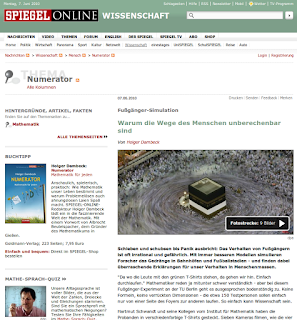
    Unser Verhalten im Gedränge

    Interessanter Artikel im Spiegel-Online über ein Experiment an der TU Berlin im Rahmen eines Forschungsprojekts vom Institut für Mathematik. Ziel soll sein verwertbare Erkenntnisse über unser Verhalten zu gewinnen, wie Menschenmengen sicherer werden können.